The Mother of All Demos
The 1968 demonstration by Douglas Engelbart and a lesson in designing technology to augment human intelligence.

The most important question is not what a machine can do. It is what people can do better because the system exists.
A question from 1968 that still matters
In December 1968, many computers were still associated with specialized laboratories, expensive equipment, and tasks performed far from everyday work. Then Douglas Engelbart and his research team presented a different idea: a computer as an interactive environment for thinking, organizing information, and collaborating with others.
The demonstration later became known as The Mother of All Demos. Its reputation often rests on a familiar list of inventions: the mouse, hypertext, windows, and remote collaboration. Yet the list can hide the more significant ambition behind the project.
Engelbart was not simply trying to make computers easier to operate. He wanted to expand what individuals and organizations could accomplish together. That distinction is especially relevant now, as companies evaluate what artificial intelligence should actually change.
A better tool is valuable. A better way of thinking and working together is transformative.
The future appeared on a screen
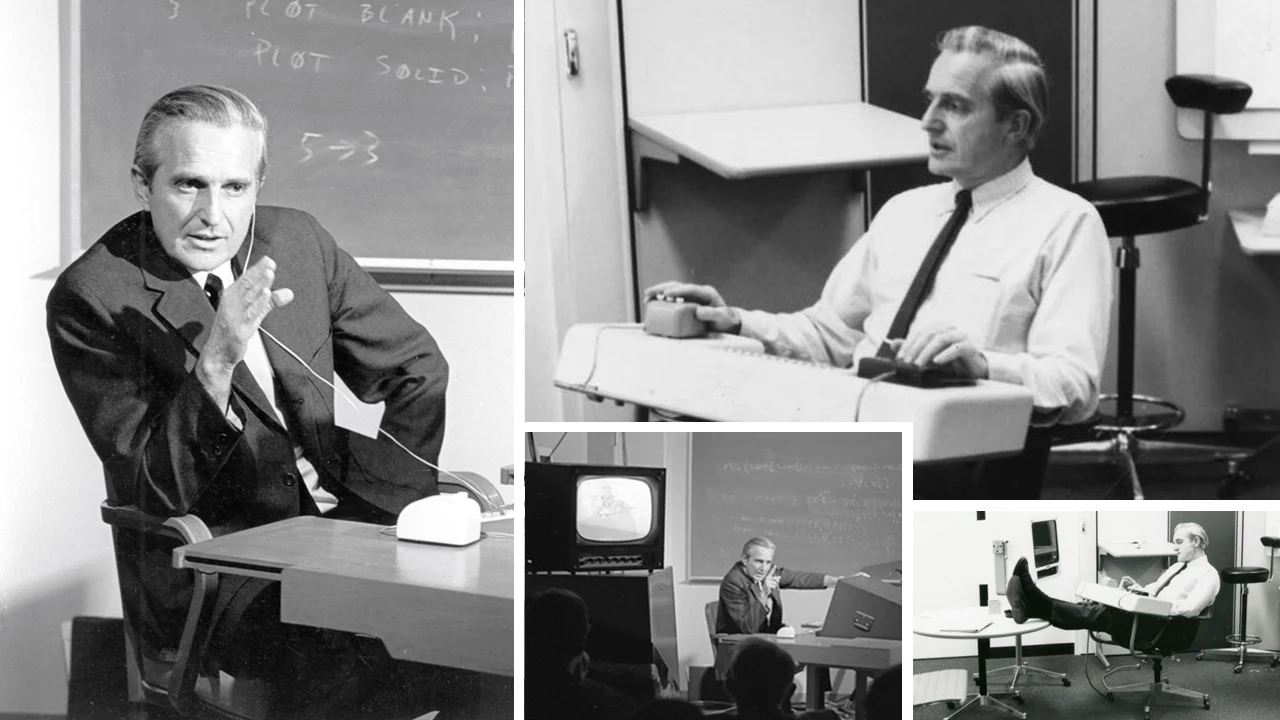
On December 9, 1968, at the Fall Joint Computer Conference in San Francisco, Engelbart and colleagues from the Augmentation Research Center at Stanford Research Institute demonstrated the oN-Line System, or NLS, in a live presentation lasting roughly ninety minutes.
A cursor responded to a handheld device. Text could be edited interactively. Information could be organized into hierarchical structures, navigated through links, and displayed in different views. Remote colleagues contributed to a shared demonstration using audio and video connections. Behind the stage, complex engineering connected the venue with systems operating at SRI in Menlo Park.
It is tempting to treat the event as a preview of products that came later. But the demonstration presented something broader: an early working model of a connected information environment. The tools were not isolated features; they were parts of a system designed around actual intellectual work.
More than the mouse
The mouse became the most recognizable symbol of Engelbart’s work, and for good reason. It changed the physical relationship between a person and what appeared on a screen. But its value emerged through the other components surrounding it.
A pointing device is useful when the software provides objects to point at. Hypertext becomes powerful when information is structured so that relationships can be followed. Collaboration matters when several people can contribute to a shared body of work instead of passing disconnected files from one desk to another.
The team also deserves recognition. Bill English played a major engineering role in developing the mouse and orchestrating the technical production of the demonstration. Describing the event as the achievement of one person would erase the collaborative effort behind the system.
The real innovation was the integration. A set of technical capabilities became meaningful because the components reinforced one another and supported a different way of working.
The idea came before the demonstration
In 1962, Engelbart had already outlined his research vision in Augmenting Human Intellect: A Conceptual Framework. He treated human problem-solving ability as a system shaped by language, tools, methods, and the training required to use them.
This perspective was unusually broad. Better hardware alone would not be sufficient. If the goal was to help people address more complex problems, the methods of working with information also needed to evolve. New tools could create new practices; those practices could reveal needs for better tools.
There is a lesson here for modern systems design. Technology and organizational behavior do not develop independently. A change in one creates dependencies in the other. A good interface does not replace clear responsibilities, just as a powerful algorithm does not automatically create a useful decision.
In Engelbart’s vision, the computer was not the center of the story. The human capability strengthened by the overall system was the objective.
A demonstration is not adoption
The San Francisco audience recognized that it had seen something important. Still, the concepts demonstrated in 1968 did not become ordinary features of working life overnight.
The path from a remarkable prototype to widespread use requires more than technological feasibility. Hardware must become affordable. Infrastructure must support the new capabilities. Interfaces must become practical for different users. Organizations must change habits, establish standards, and learn how to use the new possibilities.
Later laboratories and companies, including Xerox PARC and commercial personal-computing pioneers, helped develop and popularize related ideas. But this was not a simple sequence in which one demonstration turned directly into every modern product.
That historical distinction remains useful today. A convincing demo proves that something can work under particular conditions. Adoption asks whether it can deliver reliable value across real users, costs, constraints, and exceptions.
The parallel with enterprise AI
Nearly six decades later, artificial intelligence creates a familiar sense of possibility. A model can draft documents, analyze text, identify patterns, suggest decisions, or coordinate tools. The capabilities are impressive, and their potential is real.
But an organization can buy access to an advanced model without changing the system around it. Consider a supplier-invoice workflow. An AI service might extract the vendor, amounts, dates, and line items accurately. That is useful, but it is not the same as having a reliable payable transaction.
The broader process still needs a valid supplier, an agreed purchase context, tax and accounting rules, duplicate checks, appropriate approvals, exception handling, traceability, and ownership when something does not fit. Different technologies may perform different parts of that work: rules, APIs, an ERP, an AI model, and human judgment.
The point is not to add AI to every step. It is to determine which capabilities belong where and how they interact. A system creates business value when information, decisions, controls, and responsibilities remain coherent from beginning to end.
Designing for people, not merely for output
The next question is often framed as a competition: what will AI do better than people? That comparison is useful in specific tasks, but it is too narrow to guide the design of an enterprise system.
A better starting point is to ask what people should become more capable of doing. Can a finance team spend less time copying data and more time resolving discrepancies? Can a service team understand a customer’s context more quickly? Can a manager make a better decision because evidence and assumptions are easier to examine?
These outcomes require choices about workflows, training, information quality, and authority. They also require measuring more than the volume of generated output. Speed matters, but so do correctness, learning, adaptability, and trust.
This is where Engelbart’s thinking remains valuable: the purpose of technology is not to celebrate the tool, but to improve the capabilities of the people who use it.
The question we should ask today
History does not repeat itself neatly. Generative AI is not simply a new version of NLS, and its economic and social consequences may develop along very different paths. Yet the underlying design question is strikingly familiar.
When organizations evaluate a new technology, they can ask: What human capability are we trying to strengthen? Which parts of the existing process limit that capability? What needs to change in the way information is shared, decisions are taken, and results are validated?
Those questions may be less exciting than a spectacular demonstration. But they are more likely to reveal whether a technology will become part of a useful, sustainable system.
Engelbart’s lasting contribution is not only a collection of devices and techniques from 1968. It is a way of thinking about technology as a means of improving how people work together on difficult problems.
We should not ask only what the next generation of tools will automate. We should also ask what it will help us understand, decide, and accomplish that we could not do as well before.
Historical sources & further reading
Selected primary and institutional resources used to check historical claims. The discussion of enterprise AI is the author’s contemporary analysis.