What the Andes Teach Us About Technology, Context, and Competitive Advantage
How context, systems architecture and thoughtful technology choices shape sustainable advantage.
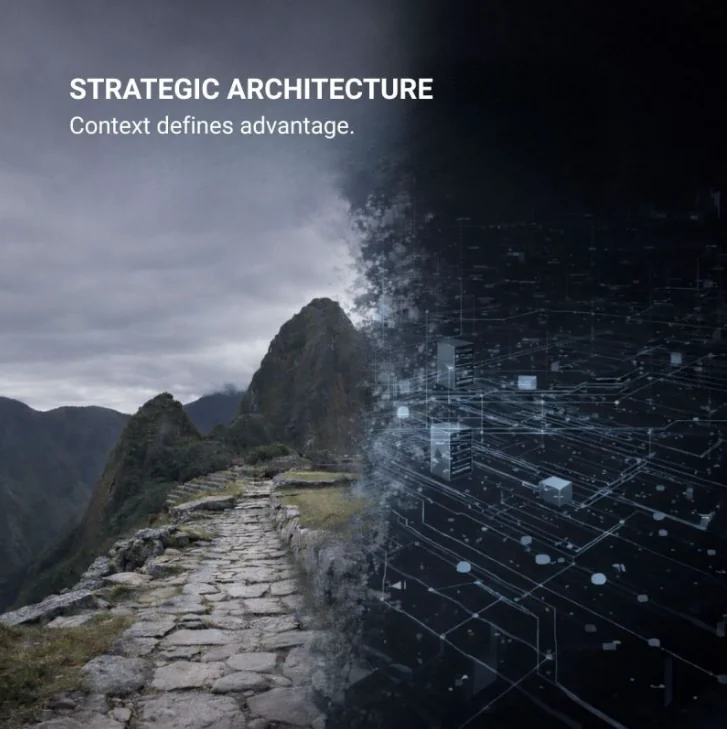
Context defines advantage. Technology matters. Architecture decides.
Strategic architecture
When people think about technological progress, they often imagine a sequence of increasingly advanced tools.
The wheel. The printing press. The steam engine. The computer. Artificial intelligence.
This perspective is understandable, but incomplete.
Because in practice, the value of a technology does not come from its novelty alone. It comes from how well it fits the system in which it operates.
That is why I find the case of the Inca world so fascinating.
The Inca Empire built one of the most remarkable logistical and administrative systems in history, not by copying the technological path of other civilizations, but by developing an architecture deeply aligned with its environment.
And I believe there is an important lesson here for modern organizations.
A system designed for its context
The territory governed by the Incas stretched across extraordinary geographical diversity: high-altitude mountains, narrow valleys, deserts, and dense forest regions.
This was not an environment where the “most obvious” transportation logic from other parts of the world would necessarily have made sense.
What emerged instead was the Qhapaq Ñan, an immense network of roads and routes extending for more than 30,000 kilometers.
But this was not just a road system. It was an integrated architecture.
A coordinated structure that connected infrastructure, mobility, communication, administration, and territorial control.
Its effectiveness did not depend on a single invention. It depended on the coherence of the whole.
The routes were adapted to the terrain. Movement relied on human transport and llamas as pack animals. Communication relied on relay runners, the chasquis. Information flowed through people, routes, and administrative mechanisms such as the khipus.
No wheeled transport system defined the architecture. And yet the architecture worked.
The wheel is not the right question
A common interpretation is to frame this as a civilization that “did not use the wheel.” But that statement can easily lead to superficial conclusions.
The more relevant point is not whether wheeled transport was absent, but whether the Inca system solved its actual logistical and administrative problems effectively.
In Andean societies, rotational principles were understood in other domains, especially in textile production. Massive stones were moved using sophisticated methods involving ramps, leverage, prepared surfaces, and coordinated labor.
The evidence does not establish that the Incas adopted wheeled vehicles or deliberately rejected them. Nor should we assume that a technique demonstrated in a modern reconstruction was necessarily used historically.
The real lesson is not that a civilization lacked intelligence because it did not adopt a particular technology.
Technological sophistication must be evaluated in relation to context, constraints, and system design.
A technology only becomes advantageous when it fits the environment in which it must operate. That idea remains just as relevant today.
Modern organizations often confuse tools with architecture
This is where the parallel with contemporary organizations becomes especially interesting.
Many businesses do not fail because they lack access to technology. They struggle because they lack architectural coherence.
They buy AI. They buy copilots. They buy automation platforms. They buy dashboards, assistants, and new digital tools.
But often they do so without redesigning the system in which those tools are expected to generate value.
The result can be predictable: more software, more subscriptions, more disconnected initiatives, and more information - but not necessarily more capability.
The problem is rarely the tool itself. The problem is that the organization has not clarified how people, processes, data, decisions, and systems should work together.
Without that, even advanced technology struggles to produce meaningful advantage.
More tools do not necessarily mean more capability.
Architecture is what makes technology useful
What made the Inca system powerful was not the isolated existence of roads, runners, or storage facilities. It was the way each component belonged to a larger design.
The same principle applies to organizations today.
Technology becomes valuable when it is part of an intentional architecture.
That architecture includes questions such as: What problem are we really solving? What constraints define our environment? How do processes, people, and information interact? Where are decisions made? What dependencies exist between systems? What must remain resilient when something fails?
These are architectural questions. And they matter more than the excitement generated by the latest trend.
Competitive advantage does not come simply from adopting a new tool before everyone else. It comes from building a system that uses technology coherently, sustainably, and strategically.
Strategic architecture begins with reality, not fashion
There is a temptation in every era to assume that the most modern technology is also the most appropriate.
But history invites us to question that assumption. We should evaluate a system by what it achieves within its circumstances, rather than by whether it resembles the technological choices of another society.
The Inca road and communication network illustrates the importance of understanding terrain, coordinating movement, organizing information, and designing for operational needs.
The historical system also served imperial administration and control. Recognizing its engineering achievements does not require romanticizing every aspect of how it operated.
Modern organizations face a different context, but a similar design question: how do we make technology support our actual objectives rather than simply follow the latest fashion?
That question matters especially now, as technological options expand faster than many organizations can absorb them.
Context defines advantage
This may be the most important lesson.
Not every technology creates value in every system. Not every innovation becomes an advantage simply because it exists. And not every organization improves by adding more tools.
Sometimes the real strategic challenge is not choosing the most advanced technology. It is designing the architecture in which technology can produce measurable, sustainable value.
In strategy, as in the Andes, context leads. Technology matters. But architecture decides.
Closing reflection
The organizations that create lasting advantage will not necessarily be the ones that adopt the most technology.
They will be the ones that best understand their environment, their constraints, their operating logic, and their strategic goals.
They will be the ones that stop asking, “What tool should we buy next?” and start asking, “What system are we actually building?” Because in the end, architecture is not about complexity. It is about coherence. And coherence is what turns technology into advantage.
A NOTE ON HISTORICAL INTERPRETATION
This article uses the Inca road and information networks as an analogy for modern architecture. It does not claim that the Incas consciously rejected wheeled transport, that all transport techniques are archaeologically established, or that the historical system was designed only for efficiency.
SELECTED HISTORICAL REFERENCES
- UNESCO World Heritage Centre. Qhapaq Ñan, Andean Road System (World Heritage listing).
- Jean-Pierre Protzen. Inca Architecture and Construction at Ollantaytambo (1993).
- Raoul d’Harcourt. Textiles of Ancient Peru and Their Techniques (English edition, 1962).
- Gordon F. Ekholm. “Wheeled Toys in Mexico,” American Antiquity (1946). Evidence relates to Mesoamerica, not directly to Inca wheeled transport.