Has Football Become Too Smart for Its Own Good?
An essay about data analytics, optimization, human judgment and the unpredictable beauty of football.
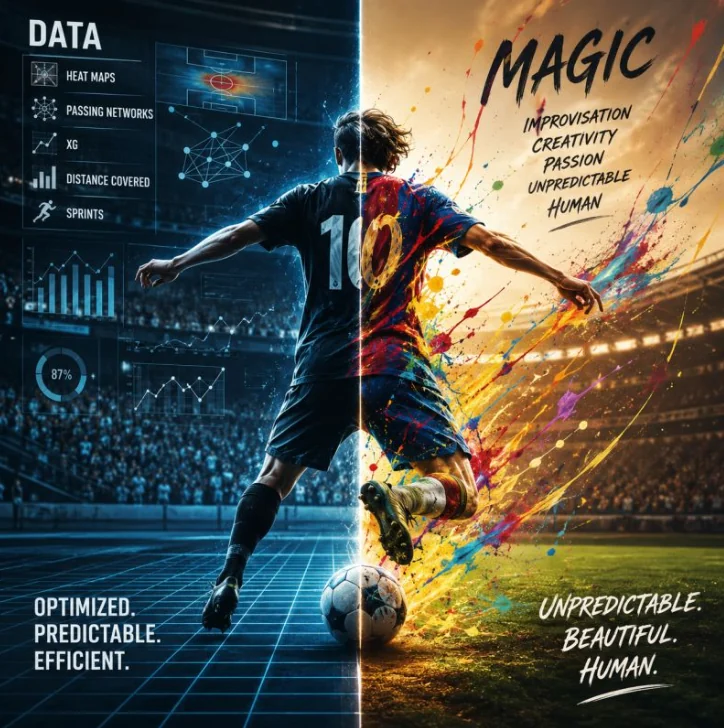
Beyond the scoreboard
There is a reason we remember certain moments in football long after we have forgotten the score. A dribble that made no tactical sense. A pass that seemed impossible. A player who saw something nobody else could see.
Today, football can measure more than ever before. That is a genuine achievement. But it also raises a question I keep coming back to: if we optimize every decision, do we risk losing some of the improvisation that makes the game worth watching?
The game behind the dashboard
Football analysis is not new. Coaches have always studied opponents, formations and patterns of play. What has changed is the depth and speed of the information available to them.
Heat maps, passing networks, pressing indicators and physical tracking data offer different views of the same match. The ability to combine event data with player movement gives analysts information that would be difficult to obtain through observation alone. FIFA now describes an ecosystem that brings together event, tracking and other forms of match data. 1
Used well, these tools can help coaches prepare, players learn and clubs make more informed decisions. There is no reason to romanticize an era in which less information was automatically better.
But more information does not eliminate the need to interpret what it means.
What a probability can - and cannot - tell us
Consider Expected Goals, or xG. It estimates the probability of a shot becoming a goal by comparing its characteristics with historical examples. Depending on the model, variables may include distance, angle, defensive pressure and the goalkeeper’s position. 2,3
A shot assigned an xG of 0.10 would, on average, be expected to produce a goal about once in ten comparable attempts. That is useful information about chance quality. It is not an instruction that a player must or must not shoot.
Imagine a winger choosing between a safe backward pass and an ambitious attempt from a difficult position. The right decision depends on far more than the shot’s estimated probability: the score, time remaining, supporting teammates, defensive shape and the player’s own strengths all matter.
Probability tells us what tends to happen. It does not prescribe what must happen in a unique moment.
When a metric becomes a target
The concern is not that clubs use metrics. It is what happens if a metric becomes the only definition of good performance.
Picture a young winger who attempts difficult dribbles. Some create chances; others surrender possession. If the surrounding culture rewards only safe completion rates, that player might gradually stop attempting the very moves that make them different.
This is a hypothetical risk, not proof that analytics is making football less creative. The same numbers could help a thoughtful coach identify exactly when a one-on-one attempt is worth encouraging.
The distinction matters: the danger is not in measuring performance, but in confusing the measurement with the purpose of the game.
A metric can be accurate and still be an incomplete definition of success.
What the numbers may leave out
Football is a constantly adapting system. Twenty-two players respond to space, pressure, fatigue, emotion, and to one another. A movement without the ball can change an entire defense. One unpredictable player can force opponents to reconsider their plan.
Analytical models continue to improve, and it would be wrong to imply they cannot capture complexity. Still, there is a difference between observing a pattern and understanding all the reasons behind it.
Confidence, timing, intention and context are not always visible in a single indicator. A team defending a narrow lead faces different trade-offs from one chasing a goal. An unsuccessful creative action may still reveal information or change how an opponent behaves.
What we can measure matters. What we have not yet measured may matter too.
Could structure actually free creativity?
There is an equally plausible counterargument: data can create more space for improvisation, not less.
A coach who understands the opposition’s shape may design movements that give a creative player more time and better opportunities. Tracking data may reveal spaces that are difficult to see from the touchline. Physical information can help teams manage workloads and preparation.
In that sense, tactical organization and individual inspiration need not compete. Sometimes the system gives a player the confidence and space to attempt the unexpected.
The point should not be to remove uncertainty from football. It should be to understand which uncertainties are worth embracing.
Good information should support human judgment, not replace it.
A lesson beyond sport
I find this question interesting because it exists outside football too. In business and technology, we measure efficiency, response times, costs and productivity. We automate processes because consistency and speed can create value.
But imagine a customer-support team measured almost entirely by how quickly it closes requests. The dashboard might improve while customers feel less understood. That does not make measurement useless; it means the definition of success was incomplete.
The same applies to enterprise systems. A process can become faster without becoming better. A decision can be data-supported without being contextually right.
The challenge is not to choose intuition over evidence, or evidence over intuition. It is to ask what outcome we actually want - and whether our metrics help us get there.
Leave room for the unexpected
So, has football become too smart for its own good? I do not think so - at least not because it has better data.
Analytics can make teams better prepared and decisions more informed. What deserves scrutiny is how those insights are used, what behaviors they reward and whether they leave enough room for intelligent risk-taking.
I do not want football to abandon analysis. I want its analysis to serve the game, not define its entire meaning.
Technology can help us understand football better. But understanding the game should never mean forgetting what makes it beautiful.
Can football become too optimized - or can better data give great players even more room to express their talent?
A NOTE ON EVIDENCE
This essay is an opinion about the possible effects of optimization. It does not claim that data analytics has been shown to reduce creativity in football. The examples of player decisions and incentives are illustrative.